
The VLSI Design Flow

The VLSI IC circuits design flow is shown in the figure below. The various level of design are numbered and the gray coloured blocks show processes in the design flow.
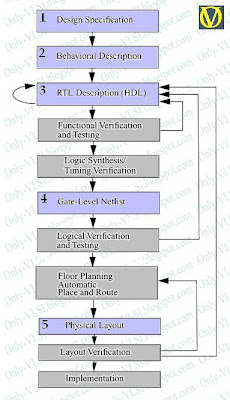
Specifications comes first, they describe abstractly the functionality, interface, and the architecture of the digital IC circuit to be designed.
  • Behavioral description is then created to analyze the design in terms of functionality, performance, compliance to given standards, and other specifications.
  • RTL description is done using HDLs. This RTL description is simulated to test functionality. From here onwards we need the help of EDA tools.
  • RTL description is then converted to a gate-level netlist using logic synthesis tools. A gate-level netlist is a description of the circuit in terms of gates and connections between them, which are made in such a way that they meet the timing, power and area specifications.
  • Finally a physical layout is made, which will be verified and then sent to fabrication.

Comments

Popular posts from this blog

Digital Design Interview Questions - All in 1

1. How do you convert a XOR gate into a buffer and a inverter (Use only one XOR gate for each)? Answer 2. Implement an 2-input AND gate using a 2x1 mux. Answer 3. What is a multiplexer? Answer A multiplexer is a combinational circuit which selects one of many input signals and directs to the only output. 4. What is a ring counter? Answer A ring counter is a type of counter composed of a circular shift register. The output of the last shift register is fed to the input of the first register. For example, in a 4-register counter, with initial register values of 1100, the repeating pattern is: 1100, 0110, 0011, 1001, 1100, so on. 5. Compare and Contrast Synchronous and Asynchronous reset. Answer Synchronous reset logic will synthesize to smaller flip-flops, particularly if the reset is gated with the logic generating the d-input. But in such a case, the combinational logic gate count grows, so the overall gate count savings may not be that significant. The clock works as a filter for sma...

One-hot Encoding

Designing a FSM is the most common and challenging task for every digital logic designer. One of the key factors for optimizing a FSM design is the choice of state coding, which influences the complexity of the logic functions, the hardware costs of the circuits, timing issues, power usage, etc. There are several options like binary encoding, gray encoding, one-hot encoding, etc. The choice of the designer depends on the factors like technology, design specifications, etc. One-hot encoding In one-hot encoding only one bit of the state vector is asserted for any given state. All other state bits are zero. Thus if there are n states then n state flip-flops are required. As only one bit remains logic high and rest are logic low, it is called as One-hot encoding. Example : If there is a FSM, which has 5 states. Then 5 flip-flops are required to implement the FSM using one-hot encoding. The states will have the following values: S0 - 10000 S1 - 01000 S2 - 00100 S3 - 00010 S4 - 00001 Adv...

Gate-Level Modeling

>> Introduction >> Gate Primitives >> Delays >> Examples Introduction In Verilog HDL a module can be defined using various levels of abstraction. There are four levels of abstraction in verilog. They are: Behavioral or algorithmic level: This is the highest level of abstraction. A module can be implemented in terms of the design algorithm. The designer no need to have any knowledge of hardware implementation. Data flow level: In this level the module is designed by specifying the data flow. Designer must how data flows between various registers of the design. Gate level: The module is implemented in terms of logic gates and interconnections between these gates. Designer should know the gate-level diagram of the design. Switch level: This is the lowest level of abstraction. The design is implemented using switches/transistors. Designer requires the knowledge of switch-level implementation details. Gate-level modeling is virtually the lowest-level of abstraction, ...